J&K Government Unveils Land Pooling Policy 2026 with 70% Consent
The J&K Government’s newly notified Land Pooling Policy mandates 70% landowner consent for urban development, aiming to enhance infrastructure through collaborative community efforts.
 admin
0 comments
admin
0 comments

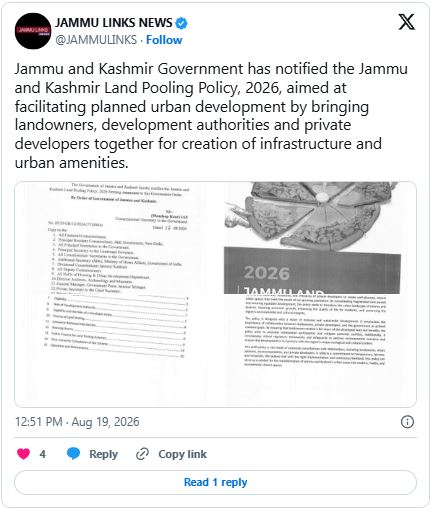
The Jammu and Kashmir (J&K) Government has officially notified the Land Pooling Policy 2026, mandating 70% consent from landowners for urban development. This policy, announced through Government Order No. 173-JK(HUD) dated August 17, 2026, aims to foster planned urban growth by securing voluntary participation from landowners willing to collaborate in development initiatives.
Under the new policy, a Developer Entity or consortium can express interest and register to develop a land parcel. A land pooling scheme can commence only if at least 70% of landowners in a contiguous region agree to take part in the registration process.
One of the cornerstone provisions allows the Developer Entity to retain 60% of the pooled area while surrendering the remaining 40% to the relevant Development Authority, free from encumbrances. This land will serve vital purposes such as infrastructure development, recreational facilities, and public amenities, aligning with the applicable Master Plan and Zonal Development Plans.
According to the policy, the land accessible to Developer Entities can be utilized for various developments, including residential, commercial, and institutional projects, as well as infrastructure enhancements that encompass public use.
Additionally, the policy introduces flexibility for redistributing benefits among participating landowners by means of developed land, built-up spaces, or other mutually agreed options for equitable exchange.
The Development Authority will oversee implementation through a Single Window System, streamlining approvals and managing overall coordination. This includes planning proposals and infrastructure, establishing rights of way, and engaging with agencies responsible for essential services like water supply and electricity.
The authority will also set up a dispute-resolution mechanism to handle issues arising during the policy’s execution, ensuring fair treatment and compliance with the set norms.
A two-tier grievance redressal mechanism accompanies the policy. The first stage features a Grievance Redressal Committee led by a Designated Land Pooling Officer, resolving complaints within 30 days. Dissatisfied parties can appeal to a second committee headed by the Vice Chairman or Chief Executive Officer of the respective Development Authority.
To support efficiency and transparency, the J&K Government envisions an online portal dedicated to the land pooling scheme. This digital platform will streamline applications, scrutiny, registration, and approvals while enhancing monitoring efforts.
The policy delineates clear timelines for various processes: forming a consortium within an initial 60-day period (which can be extended by 30 days), and submitting the land pooling scheme to the Development Authority within six months of consortium formation. The overall timeframe for completing the scheme should not exceed five years.
Moreover, the policy establishes that the Developer Entity or consortium will maintain developed areas under the land pooling arrangements, while urban local bodies will only assume responsibility for infrastructure after its completion and official handover.